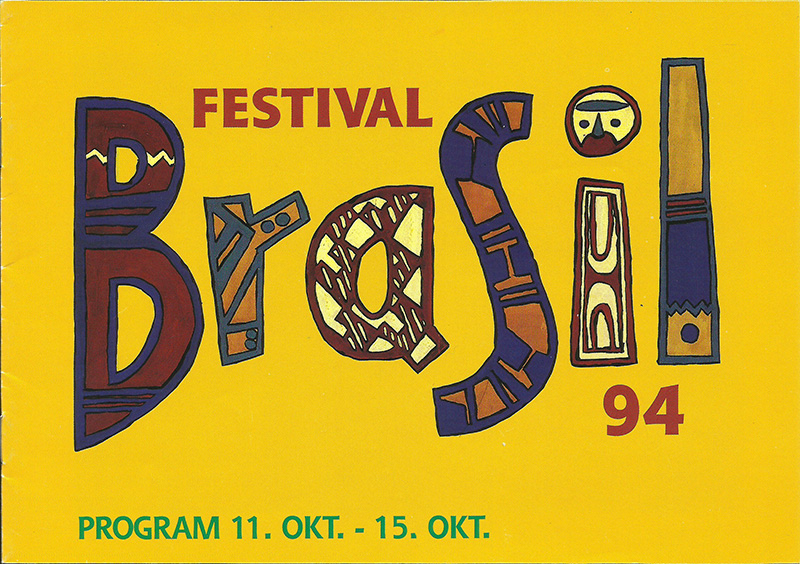
As originator and producer, Jesper Hedegaard has created two cultural festivals in Copenhagen.
Festival Brasil 94 consisted of 18 events featuring concerts, exhibitions, workshops, debates, and seminars with 35 visiting musicians, dancers, and intellectuals, including Zizi Possi, Leny Andrade, Antonio Adolfo, Joyce, and Ilê Aiyê.
Festival Brasil 94 consisted of 18 events featuring concerts, exhibitions, workshops, debates, and seminars with 35 visiting musicians, dancers, and intellectuals, including Zizi Possi, Leny Andrade, Antonio Adolfo, Joyce, and Ilê Aiyê.
From the festival’s concept:
Background
Brazil is not only the land of carnival and football, as portrayed in the media’s preferred clichés. It is home to—and a producer of—many other forms of art, social interaction, and values rooted deep in history and in the formation of Brazilian society. Carnival and football have a well-deserved place in popular culture, but in Brazilian reality they exist in interplay with many other forms of expression, each connected to the diverse components of the population.
Objectives
The festival aims to present a small selection of this cultural richness through a combination of performing arts (music, dance, video, and culinary arts) and reflections on the festival’s themes in the form of lectures and debates. In doing so, the festival seeks to give audiences the opportunity to explore multiple aspects of this cultural complexity and to provide students and practicing artists with a life-affirming source of inspiration.
Festival Brasil 94 presents some of Brazil’s leading artists and offers a picture of Brazilian cultural production at a high level of quality.

Festival Brasil 2001, with the theme of multiculturalism, presented the fruits of Brazil’s unique history of 501 years of multicultural development. The intention was to highlight Denmark’s role in a global multicultural future. The festival consisted of 40 events over 10 days, including concerts, films, dance, exhibitions, literary events, debates, seminars, and workshops, with 59 visiting musicians, dancers, and intellectuals.
From the festival’s concept:
Background
Festival Brasil first took place in 1994, when artists such as Zizi Possi, Joyce, Ilê Aiyê, and anthropologist Maria de Lourdes Siqueira were introduced to Denmark. Audiences were enthusiastic, the press was excited, and collaborators and performers shared that enthusiasm. In the years that followed, initiatives—both artistic and academic—at Danish educational institutions could be directly traced back to Festival Brasil 94.
It is this success that we now build upon. While the 1994 festival focused on breaking clichés about Brazil, the 2001 festival emphasizes the theme of multiculturalism and presents the results of Brazil’s unique 501-year multicultural history. In doing so, we aim to highlight Denmark’s role in a global multicultural future.
Brazil’s cultural richness has a depth, quality, and breadth that even more people in Denmark can benefit from. A country shaped by a multicultural composition of different ethnic, religious, and national groups, Brazil consists of nearly 30 states, each with its own cultural identity, alongside a shared Brazilian foundation rooted in African, European, and Indigenous cultures. This cultural constellation is a key reason why Brazil is highlighted by anthropologists and sociologists worldwide as an example of productive and creative multicultural coexistence.
Denmark’s dependence on external input
Denmark has no longstanding tradition of rhythmic and improvisational cultural expression. Everything has been acquired through external influence, beginning with Louis Armstrong’s visit to Denmark in 1933. Since then, Denmark has welcomed a remarkable line of jazz world stars, established several rhythmic conservatories, and gained inspiration and insight from all corners of the world. What would Denmark be without the Danish Radio Big Band, salsa venues, and all the other multicultural influences? I don’t know—but it would certainly be dull.
The festival will:
- Showcase Brazilian music, art, and culture
- Contribute to the diversity of Danish cultural life
- Highlight the debate on multiculturalism, including in relation to education and coexistence
- Promote cultural understanding through encounters between worlds
- Strengthen existing relations between Denmark and Brazil
- Create a spectacular cultural event in Copenhagen